📦 FREE SHIPPING OVER 120 RON
Order Tracking Individuals / Sales: 0745 200 357 / Orders Legal Entities: 0721 722 783
Manuscript proposals: [email protected] : 0745 204 115

 EN
EN  Romana
6359.png "Editura Universitară") Wine Legends. A Study of Food Ethnology
Wine Legends. A Study of Food Ethnology
![Wine Legends. A Study of Food Ethnology [0]](https://gomagcdn.ro/domains/editurauniversitara.ro/files/product/medium/legendele-vinului-studiu-de-etnologie-alimentara-926907.jpg "Wine Legends. A Study of Food Ethnology [0]")
![Wine Legends. A Study of Food Ethnology [1]](https://gomagcdn.ro/domains/editurauniversitara.ro/files/product/medium/legendele-vinului-studiu-de-etnologie-alimentara-253269.jpg "Wine Legends. A Study of Food Ethnology [1]")
![Wine Legends. A Study of Food Ethnology [1]](https://gomagcdn.ro/domains/editurauniversitara.ro/files/product/original/legendele-vinului-studiu-de-etnologie-alimentara-926907.jpg "Wine Legends. A Study of Food Ethnology [1]")
![Wine Legends. A Study of Food Ethnology [2]](https://gomagcdn.ro/domains/editurauniversitara.ro/files/product/original/legendele-vinului-studiu-de-etnologie-alimentara-253269.jpg "Wine Legends. A Study of Food Ethnology [2]")
Publisher: Editura Universitară
Author: Ramona Teodora Pavelescu (Chelu)
Edition: I
Pages: 190
Publisher year: 2025
ISBN: 978-606-28-2009-1
DOI: https://doi.org/10.5682/9786062820091
Product Code:
9786062820091
Do you need help?
0745 200 357
- Description
- Authors
- Content
- More details
- Reviews (0)
CONTENTS/5
ARGUMENT/9
CHAPTER I
CULTURAL AND SYMBOLISTIC REPRESENTATIONS OF WINE/15
I.1. Mythological Background/15
I.2. Wine and Sacredness/18
I.3. Histories and New Mythologies of Wine/25
I.4. Philosophies and Aesthetics of Wine /28
I.5. Methodological Aspects /35
I.5.1. The Need for Interdisciplinary Perspectives/35
I.5.2. Some Considerations on Documentation/44
CHAPTER II
HISTORIES OF WINE IN ROMANIAN CULTURE. DRĂGĂŞANI WINE /52
II.1. Histories and Traditions of Wine in Premodern Romanian Culture/52
II.2. Drăgăşani Vineyards. Historical Setting/56
II.2.1. The Winemaker/63
II.2.2. Aspects of the History of the Scientific and Administrative Development of Winemaking Activities/65
CHAPTER III
VIPE AND WINE IN ROMANIAN POPULAR CULTURE/74
III.1. Hypostases and functions of customs and myths of popular culture/74
III.2. Mythological background. Romanian traditions and customs /78
III.3. Wine legends /92
III.3.1. Popular identity legends/92
III.3.2. Legends and mystifications of the origins of certain grape varieties or wines/99
III.3.3. A historical and anthropological analysis/109
CHAPTER IV
THE IMPORTANCE OF WINE FOR THE FOOD COMMUNITY/115
IV.1. Anthropological and cultural perspectives on food/115
IV.2. Feasts and wines among Romanians/119
IV.3. Wine and gastronomy among Romanians/126
IV.4. Al.'s Gastronomicals O. Teodoreanu. A literary perspective on the anthropology of food/131
CHAPTER V
REPRESENTATIONS OF THE VINEYARD AND WINE IN ROMANIAN ART AND LITERATURE/138
V.1. The vine and wine in votive painting/138
V.2. Representations of Drăgăşani wine in Romanian literature/143
CHAPTER VI
CONTEMPORARY CONCEPTS ABOUT WINE/158
VI.1. Wine consumption as an aesthetic practice/158
VI.2. Cultural representations of wines from Drăgăşani/162
CONCLUSIONS/166
BIBLIOGRAPHY/170
ARGUMENT/9
CHAPTER I
CULTURAL AND SYMBOLISTIC REPRESENTATIONS OF WINE/15
I.1. Mythological Background/15
I.2. Wine and Sacredness/18
I.3. Histories and New Mythologies of Wine/25
I.4. Philosophies and Aesthetics of Wine /28
I.5. Methodological Aspects /35
I.5.1. The Need for Interdisciplinary Perspectives/35
I.5.2. Some Considerations on Documentation/44
CHAPTER II
HISTORIES OF WINE IN ROMANIAN CULTURE. DRĂGĂŞANI WINE /52
II.1. Histories and Traditions of Wine in Premodern Romanian Culture/52
II.2. Drăgăşani Vineyards. Historical Setting/56
II.2.1. The Winemaker/63
II.2.2. Aspects of the History of the Scientific and Administrative Development of Winemaking Activities/65
CHAPTER III
VIPE AND WINE IN ROMANIAN POPULAR CULTURE/74
III.1. Hypostases and functions of customs and myths of popular culture/74
III.2. Mythological background. Romanian traditions and customs /78
III.3. Wine legends /92
III.3.1. Popular identity legends/92
III.3.2. Legends and mystifications of the origins of certain grape varieties or wines/99
III.3.3. A historical and anthropological analysis/109
CHAPTER IV
THE IMPORTANCE OF WINE FOR THE FOOD COMMUNITY/115
IV.1. Anthropological and cultural perspectives on food/115
IV.2. Feasts and wines among Romanians/119
IV.3. Wine and gastronomy among Romanians/126
IV.4. Al.'s Gastronomicals O. Teodoreanu. A literary perspective on the anthropology of food/131
CHAPTER V
REPRESENTATIONS OF THE VINEYARD AND WINE IN ROMANIAN ART AND LITERATURE/138
V.1. The vine and wine in votive painting/138
V.2. Representations of Drăgăşani wine in Romanian literature/143
CHAPTER VI
CONTEMPORARY CONCEPTS ABOUT WINE/158
VI.1. Wine consumption as an aesthetic practice/158
VI.2. Cultural representations of wines from Drăgăşani/162
CONCLUSIONS/166
BIBLIOGRAPHY/170
Attracted by the spiritual and cultural charge of wine, we set out four years ago to produce a work on the representations and legends of this special drink. The choice was subjective in several respects. First of all, my entire biography is linked to one of the legendary wine-growing areas of Romania, Drăgăşanii and its surroundings. I noticed that this fact is rather a disadvantage for the proper research, from an anthropological point of view, of some realities that, living them day by day, we only see with great difficulty certain spiritual dimensions, for example. Then, there is the feeling that we understand and know the area very well just for the simple fact that we live there, that we are aware of its traditions and culture, which is only true to a very small extent. Thirdly, I was marked by certain representations of the wine-growing activity here, including those originating from communism, strongly ideologized, very difficult to analyze even today.
We will convert these difficulties into working premises and hypotheses, which implies, of course, an incursion into the diachrony of the theme, with readings about the reports and attitudes towards wine of some foreign authors, from countries with an oenological tradition, and of some Romanian authors from different eras. After a first stage of bibliographical documentation, we found that we need a structuring criterion, since there are several types of discourse about wine, respectively, several disciplines that have made it an object of study. We realized that there are three major hypostases that are recognized and/or attributed to it: food – in the primary sense of the term; (food) symbol – in various pre-Christian traditions and religions, cardinal in Christianity through its use in receiving the Eucharist, representing the blood of the Savior; aesthetic object – in the sense given to it especially nowadays through the extraordinary evolution of oenology and other branches that deal with its meanings and qualities, developing, against this background, a true culture of tasting.
We have presented the three hypostases, to some extent, in the chronological order of their dominance throughout history, we could say, although they have always been intertwined. Such distinctions can only be made within the framework of formal analyses, which we will try to carry out throughout this thesis.
Most authors consider that wine has never been a simple food, that it has always had a special cultural and spiritual charge. Moreover, in traditional thinking, which we find in our popular culture and in Christianity, every act and undertaking has a double meaning: one manifested in the concrete world, of everyday life, and the other being that of the resonances of our deeds in the spiritual plane. The two dimensions are closely linked, they interpenetrate, the individual simultaneously projecting and feeling each of his deeds, in both senses. Which means that, especially the first two hypostases, as we have called them, are almost impossible to separate, which forces us to treat them as such.
We will use methods and analysis tools specific to ethnology and cultural anthropology, aware of the need for interdisciplinary availability, given the types of discourse we subject to analysis. Thus, we will frequently appeal to the criteria of cultural history, to the theoretical and methodological resources of literary studies and art history. The vine and wine are recurring themes throughout the history of literature and in the history of art.
We will use, explicitly and implicitly, suggestions and methods specific to mythocriticism. We will try to have a postmodern openness to the theme, because the evolution of wine also requires such an approach. Thus, starting from the mythological background and from popular customs with and about the vine and wine, we will arrive at the aestheticization of its consumption in the present. Gastronomy and the consumption of alcoholic beverages have not escaped the phenomenon of hyper-aestheticization that manifests itself in postmodernity. On the contrary, they have contributed to it, just as wine has been involved throughout history in changes in taste and sensitivity.
It was fascinating to discover, during the documentation, that we had in Constantin Brâncoveanu a true connoisseur and taster, being a man (and ruler) whose culture was reflected in a productive way on Romanian society. We discovered, in the person of Al. O. Teodoreanu, a great refiner of cuisine and writing, but also of food anthropology, understood in its most current sense. The information he provides is of prime interest for the researcher oriented towards urban popular culture, not only towards rural culture. Moreover, the interactions between the two fault lines are experiencing more and more types of manifestations, interactions, and exchanges.
The challenge is to introduce all these representations of the vine and wine into a coherent scientific discourse, in which the data are correlated, to discover the significant connections, continuities and discontinuities in the evolution of perception and conception of the special drink we are dealing with. We relate to wine both through the prism of our senses (chemical, as some specialists call smell and taste), respectively taste and sensibilities, and through the prism of culture, because it represents an archetypal drink and, at the same time, very present, contemporary, meeting several types of needs of contemporary man.
We will structure the work in five chapters, each with subchapters according to the evolution of the demonstration and analytical description of wine. We will have an approach from the general to the particular, from the universal representations of wine to the national ones, a line that will be difficult for us to follow because sometimes the differences in attitude are great, sometimes almost non-existent. The wine trade is an old occupation on the current territory of Romania, which has also taken the path of export since ancient times, which also means a transnational perspective on this product. We will focus, finally, on the histories, legends and representations of the vineyards and wine from the cultural area of Drăgăşani, which has one of the richest winemaking traditions in Romania, the Balkans and Eastern and Central Europe. The appreciation is not at all a protocol one and is not the fruit of imaginary representations that usually work in the creation of cultural identity myths.
We will convert these difficulties into working premises and hypotheses, which implies, of course, an incursion into the diachrony of the theme, with readings about the reports and attitudes towards wine of some foreign authors, from countries with an oenological tradition, and of some Romanian authors from different eras. After a first stage of bibliographical documentation, we found that we need a structuring criterion, since there are several types of discourse about wine, respectively, several disciplines that have made it an object of study. We realized that there are three major hypostases that are recognized and/or attributed to it: food – in the primary sense of the term; (food) symbol – in various pre-Christian traditions and religions, cardinal in Christianity through its use in receiving the Eucharist, representing the blood of the Savior; aesthetic object – in the sense given to it especially nowadays through the extraordinary evolution of oenology and other branches that deal with its meanings and qualities, developing, against this background, a true culture of tasting.
We have presented the three hypostases, to some extent, in the chronological order of their dominance throughout history, we could say, although they have always been intertwined. Such distinctions can only be made within the framework of formal analyses, which we will try to carry out throughout this thesis.
Most authors consider that wine has never been a simple food, that it has always had a special cultural and spiritual charge. Moreover, in traditional thinking, which we find in our popular culture and in Christianity, every act and undertaking has a double meaning: one manifested in the concrete world, of everyday life, and the other being that of the resonances of our deeds in the spiritual plane. The two dimensions are closely linked, they interpenetrate, the individual simultaneously projecting and feeling each of his deeds, in both senses. Which means that, especially the first two hypostases, as we have called them, are almost impossible to separate, which forces us to treat them as such.
We will use methods and analysis tools specific to ethnology and cultural anthropology, aware of the need for interdisciplinary availability, given the types of discourse we subject to analysis. Thus, we will frequently appeal to the criteria of cultural history, to the theoretical and methodological resources of literary studies and art history. The vine and wine are recurring themes throughout the history of literature and in the history of art.
We will use, explicitly and implicitly, suggestions and methods specific to mythocriticism. We will try to have a postmodern openness to the theme, because the evolution of wine also requires such an approach. Thus, starting from the mythological background and from popular customs with and about the vine and wine, we will arrive at the aestheticization of its consumption in the present. Gastronomy and the consumption of alcoholic beverages have not escaped the phenomenon of hyper-aestheticization that manifests itself in postmodernity. On the contrary, they have contributed to it, just as wine has been involved throughout history in changes in taste and sensitivity.
It was fascinating to discover, during the documentation, that we had in Constantin Brâncoveanu a true connoisseur and taster, being a man (and ruler) whose culture was reflected in a productive way on Romanian society. We discovered, in the person of Al. O. Teodoreanu, a great refiner of cuisine and writing, but also of food anthropology, understood in its most current sense. The information he provides is of prime interest for the researcher oriented towards urban popular culture, not only towards rural culture. Moreover, the interactions between the two fault lines are experiencing more and more types of manifestations, interactions, and exchanges.
The challenge is to introduce all these representations of the vine and wine into a coherent scientific discourse, in which the data are correlated, to discover the significant connections, continuities and discontinuities in the evolution of perception and conception of the special drink we are dealing with. We relate to wine both through the prism of our senses (chemical, as some specialists call smell and taste), respectively taste and sensibilities, and through the prism of culture, because it represents an archetypal drink and, at the same time, very present, contemporary, meeting several types of needs of contemporary man.
We will structure the work in five chapters, each with subchapters according to the evolution of the demonstration and analytical description of wine. We will have an approach from the general to the particular, from the universal representations of wine to the national ones, a line that will be difficult for us to follow because sometimes the differences in attitude are great, sometimes almost non-existent. The wine trade is an old occupation on the current territory of Romania, which has also taken the path of export since ancient times, which also means a transnational perspective on this product. We will focus, finally, on the histories, legends and representations of the vineyards and wine from the cultural area of Drăgăşani, which has one of the richest winemaking traditions in Romania, the Balkans and Eastern and Central Europe. The appreciation is not at all a protocol one and is not the fruit of imaginary representations that usually work in the creation of cultural identity myths.
If you want to express your opinion about this product you can add a review.
write a review
Similar products
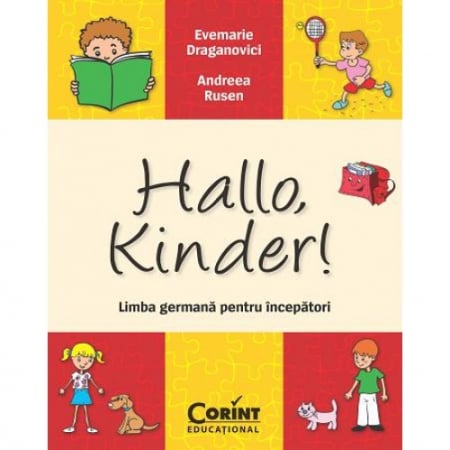
Hello, Kinder! German for beginners - Evemarie Draganovici, Andreea Rusen



English without teacher & 2 audio CDs. Instant method - Sandra Stevens