📦 FREE SHIPPING OVER 120 RON
Order Tracking Individuals / Sales: 0745 200 357 / Orders Legal Entities: 0721 722 783
Manuscript proposals: [email protected] : 0745 204 115

 EN
EN  Romana
6359.png "Editura Universitară") A Romanian to the North Pole. Following Smaranda Gheorghiu - Petre Gheorghe Barlea
A Romanian to the North Pole. Following Smaranda Gheorghiu - Petre Gheorghe Barlea
![A Romanian to the North Pole. Following Smaranda Gheorghiu - Petre Gheorghe Barlea [1]](https://gomagcdn.ro/domains/editurauniversitara.ro/files/product/original/o-romanca-spre-polul-nord-pe-urmele-smarandei-gheorghiu-767510.jpg "A Romanian to the North Pole. Following Smaranda Gheorghiu - Petre Gheorghe Barlea [1]")
Publisher: Editura Universitară
Author: Petre Gheorghe Barlea
Edition: I
Pages: 376
Publisher year: 2023
ISBN: 978-606-28-1611-7
DOI: https://doi.org/10.5682/9786062816117
Product Code:
9786062816117
Do you need help?
0745 200 357
- Description
- Browse (1)
- Authors
- Content
- More details
- Reviews (0)
Smaranda Gheorghiu, writer and social-cultural activist, enjoyed wide popularity during her lifetime - at the end of the 19th century and the beginning of the 20th century -, contemporaries appreciating her multilateral activity, the originality and boldness of some ideas , of some attitudes and facts. Later, after the old mentalities were overcome, against which she tirelessly fought, the younger generations no longer had the necessary terms of reference to understand and correctly evaluate her achievements, the hard-working pioneer sharing the fate of many of the modest pioneers of the national culture or international - pioneers whose faces gradually faded in the fog of time.
His name, however, remained inscribed in the history of several fields of activity: education, journalism, the feminist movement, cultural activism, etc. Among them, travel literature occupies a central place. And this, because Smara - as Mihai Eminescu would call her, under whose tutelage the young writer-traveler made her debut in publishing and social life - asserted herself, first of all, as a far-reaching pilgrim. Discovering her vocation early on, nurtured by a favorable family environment, Smaranda Gheorghiu subordinated all the other missions she undertook, with great courage and determination, to the act of travel.
Petre Gheorghe Barlea
His name, however, remained inscribed in the history of several fields of activity: education, journalism, the feminist movement, cultural activism, etc. Among them, travel literature occupies a central place. And this, because Smara - as Mihai Eminescu would call her, under whose tutelage the young writer-traveler made her debut in publishing and social life - asserted herself, first of all, as a far-reaching pilgrim. Discovering her vocation early on, nurtured by a favorable family environment, Smaranda Gheorghiu subordinated all the other missions she undertook, with great courage and determination, to the act of travel.
Petre Gheorghe Barlea
-
A Romanian to the North Pole. Following Smaranda Gheorghiu
Download
PETRE GHEORGHE BARLEA
INTRODUCTORY STUDY (M. V. Constantin) / 9
NOTE ON THE EDITION / 31
PLEA FOR A TRAVEL WRITER / 33
BARGAINING OVERLAYED IMAGES / 36
A family of patriotic scholars / 53
"The Road of Ialomita" / 74
Birth certificate of a modern road / 76
Towards the foothills of the Carpathians / 79
School years / 87
IN THE WAVE OF LIFE / 103
Marriage to George O. Garbea / 103
Institutes in Sinaia / 112
In Ploiesti. Journalistic debut / 123
The first literary attempts / 129
Through the spa resorts / 141
THROUGH EUROPE / 168
Adriatic / 169
Extended stopover in the Eternal City / 174
Paris. Encounters with art and literature / 181
At Versailles and Trianon / 192
"Helvetia". The road to Ragaz / 195
Rome. At the Congress of Orientalists / 199
Romanian festival at Trajan's Column / 205
"A ROMANIAN TO THE NORTH POLE" / 216
To the fjords, with Lapland‑Express / 228
"The North Pole... Boundlessness" / 230
The meeting with the Eskimos / 232
Visiting Henrik Ibsen / 236
OTHER AND OTHER ROADS / 250
Traveling conference. Oratories in the service of universal peace / 251
Across the country, to honor the memory of the great ancestors / 266
An active literary presence / 282
"Itinerera" journalists / 290
Didactic journey / 300
A BOLD PROJECT: TRAVEL AROUND THE WORLD / 315
"Sketches and memories from Czechoslovakia" / 315
In the world of diplomacy and the arts / 320
Travels to the East / 324
Significant anniversaries / 340
From the notes of an octogenarian / 345
Last trips. Achievements and abandoned projects / 347
The speech of the statues / 348
BIBLIOGRAPHY / 364
NOTE ON THE EDITION / 31
PLEA FOR A TRAVEL WRITER / 33
BARGAINING OVERLAYED IMAGES / 36
A family of patriotic scholars / 53
"The Road of Ialomita" / 74
Birth certificate of a modern road / 76
Towards the foothills of the Carpathians / 79
School years / 87
IN THE WAVE OF LIFE / 103
Marriage to George O. Garbea / 103
Institutes in Sinaia / 112
In Ploiesti. Journalistic debut / 123
The first literary attempts / 129
Through the spa resorts / 141
THROUGH EUROPE / 168
Adriatic / 169
Extended stopover in the Eternal City / 174
Paris. Encounters with art and literature / 181
At Versailles and Trianon / 192
"Helvetia". The road to Ragaz / 195
Rome. At the Congress of Orientalists / 199
Romanian festival at Trajan's Column / 205
"A ROMANIAN TO THE NORTH POLE" / 216
To the fjords, with Lapland‑Express / 228
"The North Pole... Boundlessness" / 230
The meeting with the Eskimos / 232
Visiting Henrik Ibsen / 236
OTHER AND OTHER ROADS / 250
Traveling conference. Oratories in the service of universal peace / 251
Across the country, to honor the memory of the great ancestors / 266
An active literary presence / 282
"Itinerera" journalists / 290
Didactic journey / 300
A BOLD PROJECT: TRAVEL AROUND THE WORLD / 315
"Sketches and memories from Czechoslovakia" / 315
In the world of diplomacy and the arts / 320
Travels to the East / 324
Significant anniversaries / 340
From the notes of an octogenarian / 345
Last trips. Achievements and abandoned projects / 347
The speech of the statues / 348
BIBLIOGRAPHY / 364
Smaranda Gheorghiu, writer and social-cultural activist, enjoyed wide popularity during her lifetime - at the end of the 19th century and the first half of the 20th century -, contemporaries appreciating her multilateral activity, originality and the audacity of ideas, attitudes and deeds. Later, after the old mentalities were overcome, against which she tirelessly fought, the younger generations no longer had the necessary terms of reference to understand and correctly evaluate her achievements, the diligent pioneer sharing the fate of many of the modest pioneers of roads from national or international culture - pioneers whose faces gradually faded in the fog of time.
His name, however, remained inscribed in the history of several fields of activity: education, journalism, literature, feminist movement, cultural activism etc. Among them, travel literature occupies a central place. And this, because Smara - as Mihai Eminescu would call her, under whose tutelage the young writer-traveler made her debut in publishing and social-public life - asserted herself, first of all, as a far-reaching pilgrim. Discovering her vocation early on, nurtured by a favorable family environment, Smaranda Gheorghiu subordinated all the other missions she undertook, with great courage and determination, to the act of travel.
Devoted servant of Romanian education, founder of the "outdoor school" in our country, she has, among other merits, that of having demonstrated, theoretically and practically, the importance of school trips and hikes as highly effective methods in the instructional process -educational. As a journalist and man of letters, he fought to overcome some prejudices, stimulating interest in the direct knowledge of people and their living environments, by traveling to the "hot spots" of the development of its contemporary history, formulating, in this sense , a revealing profession of faith for shaping her spiritual profile: "My passion as a writer was travel."
Smaranda Gheorghiu was the first female lecturer in our country, then one of the initiators of the Romanian feminist movement and an active supporter of the fight for the emancipation of women worldwide, being part of the organizing committees of some international congresses for peace and rapprochement between peoples on the path of culture and the peaceful education of the masses. In each of the mentioned poses, as well as in those of founder of some cultural-scientific associations and restorer - famous in the era - of dozens of Romanian historical and cultural monuments, she traveled the length and breadth of the country, and later she traveled the world, proving to be a fervent propagandist of the Romanian cause abroad. With a skill that only born globetrotters have, he knew how to divide his time and energy between travel with an official destination and that of pleasure, contributing to the formation of contemporaries' taste for pilgrimages and trying to sketch the portrait of the ideal traveler, through public exhibitions , through press articles and highly appreciated travel books at the turn of the 19th and 20th centuries.
Starting from these defining attributes of Smaranda Gheorghiu's personality, this book was not conceived as a monograph, but, rather, as a history of a life, as a "guide" that invites you to "read" a life dedicated to knowing the facts and the aspirations of the people from which the tireless militant writer rose. The biographical details have been selected and structured in such a way as to give a complete picture of the scholar-traveller, because everything Smaranda Gheorghiu achieved must be directly related to the passion of travel. Having as its central axis the detailed presentation of the trip she undertook to the North Cape, in 1902, the book follows and describes, under the title borrowed from the famous brochure that popularized her "adventure", almost all of the publicist's travels, from small hikes in the picturesque area of his native Dambovita, until the big project of traveling around the world. Each of these reconstituted itineraries has the purpose of offering the reader the model of a life devoted to the public good and, at the same time, the image of roads and places with deep meanings in national and universal history.
His name, however, remained inscribed in the history of several fields of activity: education, journalism, literature, feminist movement, cultural activism etc. Among them, travel literature occupies a central place. And this, because Smara - as Mihai Eminescu would call her, under whose tutelage the young writer-traveler made her debut in publishing and social-public life - asserted herself, first of all, as a far-reaching pilgrim. Discovering her vocation early on, nurtured by a favorable family environment, Smaranda Gheorghiu subordinated all the other missions she undertook, with great courage and determination, to the act of travel.
Devoted servant of Romanian education, founder of the "outdoor school" in our country, she has, among other merits, that of having demonstrated, theoretically and practically, the importance of school trips and hikes as highly effective methods in the instructional process -educational. As a journalist and man of letters, he fought to overcome some prejudices, stimulating interest in the direct knowledge of people and their living environments, by traveling to the "hot spots" of the development of its contemporary history, formulating, in this sense , a revealing profession of faith for shaping her spiritual profile: "My passion as a writer was travel."
Smaranda Gheorghiu was the first female lecturer in our country, then one of the initiators of the Romanian feminist movement and an active supporter of the fight for the emancipation of women worldwide, being part of the organizing committees of some international congresses for peace and rapprochement between peoples on the path of culture and the peaceful education of the masses. In each of the mentioned poses, as well as in those of founder of some cultural-scientific associations and restorer - famous in the era - of dozens of Romanian historical and cultural monuments, she traveled the length and breadth of the country, and later she traveled the world, proving to be a fervent propagandist of the Romanian cause abroad. With a skill that only born globetrotters have, he knew how to divide his time and energy between travel with an official destination and that of pleasure, contributing to the formation of contemporaries' taste for pilgrimages and trying to sketch the portrait of the ideal traveler, through public exhibitions , through press articles and highly appreciated travel books at the turn of the 19th and 20th centuries.
Starting from these defining attributes of Smaranda Gheorghiu's personality, this book was not conceived as a monograph, but, rather, as a history of a life, as a "guide" that invites you to "read" a life dedicated to knowing the facts and the aspirations of the people from which the tireless militant writer rose. The biographical details have been selected and structured in such a way as to give a complete picture of the scholar-traveller, because everything Smaranda Gheorghiu achieved must be directly related to the passion of travel. Having as its central axis the detailed presentation of the trip she undertook to the North Cape, in 1902, the book follows and describes, under the title borrowed from the famous brochure that popularized her "adventure", almost all of the publicist's travels, from small hikes in the picturesque area of his native Dambovita, until the big project of traveling around the world. Each of these reconstituted itineraries has the purpose of offering the reader the model of a life devoted to the public good and, at the same time, the image of roads and places with deep meanings in national and universal history.
If you want to express your opinion about this product you can add a review.
write a review
Similar products
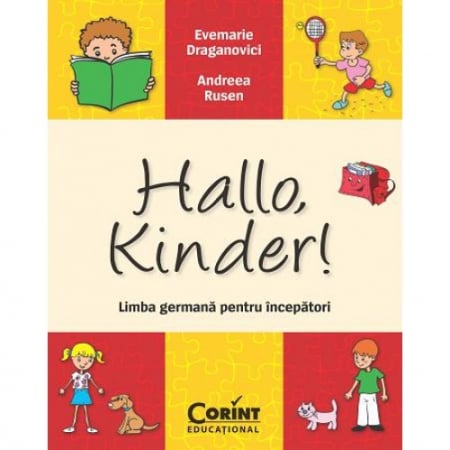
Hello, Kinder! German for beginners - Evemarie Draganovici, Andreea Rusen



English without teacher & 2 audio CDs. Instant method - Sandra Stevens
Romanian-Latin dictionary - Virgil Matei