📦 FREE SHIPPING OVER 120 RON
Order Tracking Individuals / Sales: 0745 200 357 / Orders Legal Entities: 0721 722 783
Manuscript proposals: [email protected] : 0745 204 115

 EN
EN  Romana
6359.png "Editura Universitară") Historia de la Escuela de Artillería y Aplicación de Misiles "Ioan Vodă".
Historia de la Escuela de Artillería y Aplicación de Misiles "Ioan Vodă".
![Historia de la Escuela de Artillería y Aplicación de Misiles "Ioan Vodă". [0]](https://gomagcdn.ro/domains/editurauniversitara.ro/files/product/medium/istoria-scolii-de-aplicatie-pentru-artilerie-si-rachete-ioan-voda-846156.jpg "Historia de la Escuela de Artillería y Aplicación de Misiles \"Ioan Vodă\". [0]")
![Historia de la Escuela de Artillería y Aplicación de Misiles "Ioan Vodă". [1]](https://gomagcdn.ro/domains/editurauniversitara.ro/files/product/medium/istoria-scolii-de-aplicatie-pentru-artilerie-si-rachete-ioan-voda-176658.jpg "Historia de la Escuela de Artillería y Aplicación de Misiles \"Ioan Vodă\". [1]")
![Historia de la Escuela de Artillería y Aplicación de Misiles "Ioan Vodă". [1]](https://gomagcdn.ro/domains/editurauniversitara.ro/files/product/original/istoria-scolii-de-aplicatie-pentru-artilerie-si-rachete-ioan-voda-846156.jpg "Historia de la Escuela de Artillería y Aplicación de Misiles \"Ioan Vodă\". [1]")
![Historia de la Escuela de Artillería y Aplicación de Misiles "Ioan Vodă". [2]](https://gomagcdn.ro/domains/editurauniversitara.ro/files/product/original/istoria-scolii-de-aplicatie-pentru-artilerie-si-rachete-ioan-voda-176658.jpg "Historia de la Escuela de Artillería y Aplicación de Misiles \"Ioan Vodă\". [2]")
Publisher: Editura Universitară
Author: Gheorghe Bichicean
Edition: I
Pages: 340
Publisher year: 2026
ISBN: 978-606-28-2201-9
DOI: https://doi.org/10.5682/9786062822019
Product Code:
9786062822019
Do you need help?
0745 200 357
- Description
- Authors
- More details
- Content
- Reviews (0)
The 145th anniversary of the establishment of the "Ioan Vodă" Artillery and Missile Application School offers the opportunity not only for a historical assessment, but also for a reflection on the profound meaning of the military tradition and the role that this institution has played, uninterruptedly, in the training of artillery officers of the Romanian Army. In the spirit of the motto that opens this volume - "Tradition is not the preservation of ashes, but the transmission of fire" - the history of the Application School is revealed as a living process of professional continuity. Artillery fire does not only mean the power of the weapon, but also the fire of knowledge, of intellectual discipline and of mastery of the science that governs the trajectory, calculation and responsibility of the command. This is the fire that is transmitted from generation to generation, through instruction, exercise and example.
Since its inception, the Artillery Application School has been conceived as an elite institution of Romanian military education, designed to ensure thorough training, adapted to the requirements of the battlefield and the continuous evolution of military technology. Its institutional history faithfully reflects the transformations of the army and military doctrine, from the affirmation of the modern Romanian state to the contemporary demands of integrated defense. Throughout these 145 years, successive generations of officers have been trained under the sign of rigor, professionalism and responsibility towards the entrusted mission. It is no coincidence that artillery has been perceived, since the era of the modernization of the Romanian army, as a weapon of science and precision. King Carol I, himself an artillery officer, expressed on the anniversary of the War of Independence the wish that artillery would remain the "ornament of the army" - a formula that synthesizes the ideal of professional excellence and institutional prestige that the Application School has constantly served. This volume aims to provide a rigorous synthesis of the evolution of the "Ioan Vodă" Artillery and Missile Application School in a revised and completed edition, following both its historical and institutional dimension, as well as its formative contribution within the Romanian Army. The traditions, personalities and experiences that have consolidated the identity of this institution and ensured the professional continuity of the artillery branch are highlighted.
After 2000, the year in which we published the first book dedicated to the history of the Application School, accompanied by unpublished information regarding the establishment of the modern Romanian artillery in 1843, a series of works were published, most of them written or coordinated by General Dr. Adrian Stroea, among which we mention: "165 years of existence of modern Romanian artillery" (collective of authors) Bucharest, 2008; "Encyclopedia of Romanian Artillery" (coordinator: col. prof.univ. dr. Adrian Stroea collective of authors:); Col. prof.univ. dr. Adrian Stroea Col. (r) Marin G., "180 years since the establishment of modern Romanian artillery" (Brigadier General (r) prof. Dr. Adrian Stroea, in "Bulletinul Arhivelor Militare Române", Year XXVII, no. 3 (105), 2024), Col. Adrian Stroea, col. (r) Marin Ghinoiu, Din elita artileriei, Publishing House of the Technical-Editorial Center of the Army, Bucharest, 2012, etc.
For this second edition, some corrections were also needed, because previously we took over information that later proved not to be supported by historical sources, for example Nicolae Bălcescu's letter to Ghica from 1843, in which he would have requested to go to Paris to train in artillery.
This anniversary work is addressed to military personnel, researchers in the field of military history and all those interested in the values and traditions of the Romanian Army. It is, at the same time, a tribute to those who, through vocation, competence and devotion, have passed on the fire of the artillery profession.
My thanks are addressed to those who responded to the requests for updating the data, to the museographer Nicolae Adrian Alexe from Brașov and, first of all, to the colonel in reserve Florian Ciocan, who proved to be an excellent collaborator and a fine researcher of the sources of artillery history.
Since its inception, the Artillery Application School has been conceived as an elite institution of Romanian military education, designed to ensure thorough training, adapted to the requirements of the battlefield and the continuous evolution of military technology. Its institutional history faithfully reflects the transformations of the army and military doctrine, from the affirmation of the modern Romanian state to the contemporary demands of integrated defense. Throughout these 145 years, successive generations of officers have been trained under the sign of rigor, professionalism and responsibility towards the entrusted mission. It is no coincidence that artillery has been perceived, since the era of the modernization of the Romanian army, as a weapon of science and precision. King Carol I, himself an artillery officer, expressed on the anniversary of the War of Independence the wish that artillery would remain the "ornament of the army" - a formula that synthesizes the ideal of professional excellence and institutional prestige that the Application School has constantly served. This volume aims to provide a rigorous synthesis of the evolution of the "Ioan Vodă" Artillery and Missile Application School in a revised and completed edition, following both its historical and institutional dimension, as well as its formative contribution within the Romanian Army. The traditions, personalities and experiences that have consolidated the identity of this institution and ensured the professional continuity of the artillery branch are highlighted.
After 2000, the year in which we published the first book dedicated to the history of the Application School, accompanied by unpublished information regarding the establishment of the modern Romanian artillery in 1843, a series of works were published, most of them written or coordinated by General Dr. Adrian Stroea, among which we mention: "165 years of existence of modern Romanian artillery" (collective of authors) Bucharest, 2008; "Encyclopedia of Romanian Artillery" (coordinator: col. prof.univ. dr. Adrian Stroea collective of authors:); Col. prof.univ. dr. Adrian Stroea Col. (r) Marin G., "180 years since the establishment of modern Romanian artillery" (Brigadier General (r) prof. Dr. Adrian Stroea, in "Bulletinul Arhivelor Militare Române", Year XXVII, no. 3 (105), 2024), Col. Adrian Stroea, col. (r) Marin Ghinoiu, Din elita artileriei, Publishing House of the Technical-Editorial Center of the Army, Bucharest, 2012, etc.
For this second edition, some corrections were also needed, because previously we took over information that later proved not to be supported by historical sources, for example Nicolae Bălcescu's letter to Ghica from 1843, in which he would have requested to go to Paris to train in artillery.
This anniversary work is addressed to military personnel, researchers in the field of military history and all those interested in the values and traditions of the Romanian Army. It is, at the same time, a tribute to those who, through vocation, competence and devotion, have passed on the fire of the artillery profession.
My thanks are addressed to those who responded to the requests for updating the data, to the museographer Nicolae Adrian Alexe from Brașov and, first of all, to the colonel in reserve Florian Ciocan, who proved to be an excellent collaborator and a fine researcher of the sources of artillery history.
Sibiu, 2026
Prólogo/11
Argumento/14
I. CREACIÓN DE LA ESCUELA DE ARTILLERÍA/17
1. Marco general. Creación de la artillería rumana moderna el 10 de noviembre de 1843/17
2. Creación de la Escuela de Artillería. Escuela Especial de Artillería e Ingeniería - 7 de abril de 1881/30
3. Reforma de 1895. Creación de las Escuelas Militares de Artillería. Organización y funcionamiento/49
4. Reformas educativas en 1910-1912/95
5. Formación de oficiales de artillería durante la Primera Guerra Mundial/107
II. LA ESCUELA DE APLICACIÓN DE TIMIȘOARA: 1920-1939/114
1. Timișoara, 1920. Restablecimiento de la Escuela de Aplicación/114
2. La Escuela de Aplicación durante 1922-1939/127
3. Visitas reales, inspecciones, celebraciones y conmemoraciones durante 1922-1938/154
4. El año escolar 1938-1939. Disolución de la Escuela de Aplicación de Artillería/166
III. RESTABLECIMIENTO DE LA ESCUELA EN 1997. LA ESCUELA DE APLICACIÓN DE ARTILLERÍA Y COHETES “IOAN VODĂ”/169
1. Panorama general de las reformas en la educación militar/169
2. Restablecimiento de la Escuela de Aplicaciones de Artillería. Sibiu, 1997/175
IV. COMANDANTES DE ESCUELAS DE APLICACIÓN/ 205
1. Comandantes de la Escuela Especial de Artillería e Ingenieros en el período 1881-1895/205
Eracle Arion - el primer comandante de la Escuela de Aplicación de Artillería - (1881-1882) /205
Dimitrie Dumitrescu Maican (1882-1883/218)
Constantino I. Brătianu (1883-1884) /222
Constantino Poenaru (1884-1887)/ 226
Vasile Cremineanu (1887-1888) / 229
Alejandro Tell (1888-1889) / 232
Constantin Crătunescu (1889) /236
George Grămăticescu (1889-1892) /239
Petre Vasiliu Nasturel (1892-1893) / 242
Gheorghe Mares (1893-1895) / 252
2. Comandantes de la Escuela de Aplicación de Artillería e Ingenieros en el período 1895-1914 / 259
Mihail Stroescu (1895-1896) / 259
Ion Aronovici (1896 - 1901) / 261
Nicolae Popovici (1901-1904) / 266
Dumitru Rujinski (1904-1907) / 268
Eremia Grigorescu (1907-1910) / 272
Ştefănescu Dumitru (1910 - 1911) / 277
Alejandro Referendáru (1911-1912) / 282
Ion Vernescu (1912-1915)/ 287
3. Comandantes de la Escuela de Aplicación de Artillería de Timişoara (1920-1939)/ 294
Rómulo Brătuianu (1920-1921)/ 294
Mihail Skelletti (1921) / 297
Ştefan Orescovici (1921-1926) / 302
Gheorghe Buicliu (1926 -1928) / 306
Ioan I. Carlaonţ (1928-1933)/ 308
Octavio Georgescu (1933-1936) / 310
Alejandro I. Nicolau (1936-1938)/ 312
Chirnoagă Gh. Platón (1939)/ 314
4. Comandantes de la Escuela de Aplicación de Artillería y Misiles "Ioan Voda / 319
Neculai Rotaru (1997-1999)/ 319
Eugen Popescu (1999-2002) / 321
Autores/324
Bibliografía /331
Argumento/14
I. CREACIÓN DE LA ESCUELA DE ARTILLERÍA/17
1. Marco general. Creación de la artillería rumana moderna el 10 de noviembre de 1843/17
2. Creación de la Escuela de Artillería. Escuela Especial de Artillería e Ingeniería - 7 de abril de 1881/30
3. Reforma de 1895. Creación de las Escuelas Militares de Artillería. Organización y funcionamiento/49
4. Reformas educativas en 1910-1912/95
5. Formación de oficiales de artillería durante la Primera Guerra Mundial/107
II. LA ESCUELA DE APLICACIÓN DE TIMIȘOARA: 1920-1939/114
1. Timișoara, 1920. Restablecimiento de la Escuela de Aplicación/114
2. La Escuela de Aplicación durante 1922-1939/127
3. Visitas reales, inspecciones, celebraciones y conmemoraciones durante 1922-1938/154
4. El año escolar 1938-1939. Disolución de la Escuela de Aplicación de Artillería/166
III. RESTABLECIMIENTO DE LA ESCUELA EN 1997. LA ESCUELA DE APLICACIÓN DE ARTILLERÍA Y COHETES “IOAN VODĂ”/169
1. Panorama general de las reformas en la educación militar/169
2. Restablecimiento de la Escuela de Aplicaciones de Artillería. Sibiu, 1997/175
IV. COMANDANTES DE ESCUELAS DE APLICACIÓN/ 205
1. Comandantes de la Escuela Especial de Artillería e Ingenieros en el período 1881-1895/205
Eracle Arion - el primer comandante de la Escuela de Aplicación de Artillería - (1881-1882) /205
Dimitrie Dumitrescu Maican (1882-1883/218)
Constantino I. Brătianu (1883-1884) /222
Constantino Poenaru (1884-1887)/ 226
Vasile Cremineanu (1887-1888) / 229
Alejandro Tell (1888-1889) / 232
Constantin Crătunescu (1889) /236
George Grămăticescu (1889-1892) /239
Petre Vasiliu Nasturel (1892-1893) / 242
Gheorghe Mares (1893-1895) / 252
2. Comandantes de la Escuela de Aplicación de Artillería e Ingenieros en el período 1895-1914 / 259
Mihail Stroescu (1895-1896) / 259
Ion Aronovici (1896 - 1901) / 261
Nicolae Popovici (1901-1904) / 266
Dumitru Rujinski (1904-1907) / 268
Eremia Grigorescu (1907-1910) / 272
Ştefănescu Dumitru (1910 - 1911) / 277
Alejandro Referendáru (1911-1912) / 282
Ion Vernescu (1912-1915)/ 287
3. Comandantes de la Escuela de Aplicación de Artillería de Timişoara (1920-1939)/ 294
Rómulo Brătuianu (1920-1921)/ 294
Mihail Skelletti (1921) / 297
Ştefan Orescovici (1921-1926) / 302
Gheorghe Buicliu (1926 -1928) / 306
Ioan I. Carlaonţ (1928-1933)/ 308
Octavio Georgescu (1933-1936) / 310
Alejandro I. Nicolau (1936-1938)/ 312
Chirnoagă Gh. Platón (1939)/ 314
4. Comandantes de la Escuela de Aplicación de Artillería y Misiles "Ioan Voda / 319
Neculai Rotaru (1997-1999)/ 319
Eugen Popescu (1999-2002) / 321
Autores/324
Bibliografía /331
If you want to express your opinion about this product you can add a review.
write a review
Similar products


Heritage slums. Saint Catherine and the Flemish - Ana Rubeli
In storms of steel. Second edition - Ernst Junger
The Quest for Power: Europe 1815-1914 - Richard J. Evans
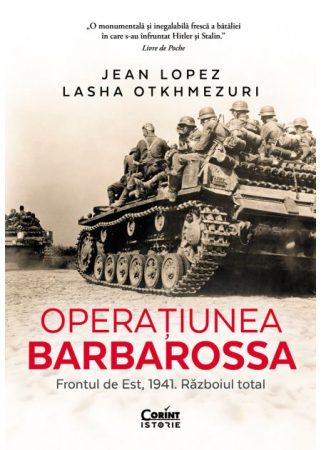
Operation Barbarossa. Eastern Front, 1941. Total War - Jean Lopez Lasha Otkhmezuri
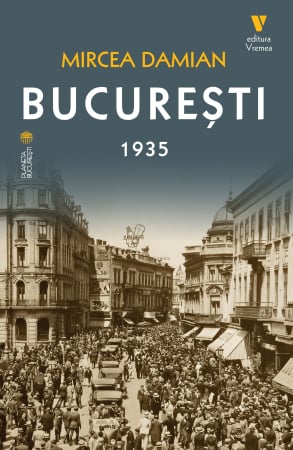
Bucharest 1935 - Mircea Damian