📦 FREE SHIPPING OVER 120 RON
Order Tracking Individuals / Sales: 0745 200 357 / Orders Legal Entities: 0721 722 783
Manuscript proposals: [email protected] : 0745 204 115

 EN
EN  Romana
6359.png "Editura Universitară") Petru Emanoil Efesiu and the importance of his work for church music of the Byzantine tradition in the Romanian Countries - Marius Stelian Miltaru
Petru Emanoil Efesiu and the importance of his work for church music of the Byzantine tradition in the Romanian Countries - Marius Stelian Miltaru
![Petru Emanoil Efesiu and the importance of his work for church music of the Byzantine tradition in the Romanian Countries - Marius Stelian Miltaru [1]](https://gomagcdn.ro/domains/editurauniversitara.ro/files/product/original/petru-emanoil-efesiu-si-importanta-operei-sale-pentru-muzica-bisericeasca-de-traditie-bizantina-din-tarile-romane-079573.jpg "Petru Emanoil Efesiu and the importance of his work for church music of the Byzantine tradition in the Romanian Countries - Marius Stelian Miltaru [1]")
Publisher: Editura Universitară
Publisher year: 2022
Author: Marius Stelian Miltaru
Edition: I
Pages: 340
ISBN: 978-606-28-1490-8
DOI: https://doi.org/10.5682/9786062814908
- Description
- Browse (1)
- More details
- Content
- Reviews (0)
Rev. Prof. Univ. Dr. Vasile Stanciu,
Director of the Doctoral School of Theology in Cluj-Napoca
-
Petru Emanoil Efesiu and the importance of his work for church music of the Byzantine tradition in the Romanian Countries
Download
The contribution of Petru Efesiu to the edification of modern Romanian psaltery cannot be quantified, given that he is the one who introduced the new system in Wallachia, later spread throughout the Romanian space through his disciples, as well as the manuscripts and prints containing his works. Also, the prints themselves probably represent the most valuable legacy that this psalt native from New Ephesus left to posterity, as the founder of Eastern musical print.
A technical personality par excellence, most likely with long years of study and practice, given that he came to Bucharest after forty years had passed, Petru Efesiu was, perhaps, too preoccupied with his art to pay attention to major events that happened around him - be they political or cultural - and that made his efforts seem, at least during his life, to be in vain. Even so, as a testimony of his tenacity, he did not give up making plans for new compositions and musical editions until the end of his life.
The period of approximately five years in which the school and - later - the printing house led by the psalter originally from New Ephesus was active, represents, in my view, the founding moment of the current Romanian psalter, by transposing a significant number of compositions into the new system, printing the first church music books and the formation in the spirit of the reform of some of the most important psalters, such as Macarie Ieromonahul, Anton Pann, Costache Chiosea, Panaiot Enghiurliu s.a.m.d.
Personally, my affinity for Petru Efesiu manifested itself from the moment when my professional development brought me to the place where he is supposed to have once been, namely a singer in the right pew of the Patriarchal Cathedral in Bucharest, as well as by participating in the many concerts in Greece, where I came into direct contact with the living legacy of this psalt, to which I considered it appropriate, in the view of posterity, to dedicate the present work.
STAGE OF RESEARCHERS / 11
I
HISTORICAL FRAMEWORK
I.1. General historical context. Ottoman Empire. The situation of the Greeks and the Ecumenical Patriarchate / 16
I.2. Phanariote reigns in the Romanian Countries at the beginning of the 19th / 20th century
I.3. Greek influence in the Romanian Principalities / 23
I.4. The situation of the Romanian Orthodox Church during the Phanariot period / 27
I.5. Education in the Romanian Principalities at the end of the Phanariot era / 33
I.6. Print / 39
I.7. Church music in the Romanian Principalities between the 18th and 19th centuries / 46
II
THE LIFE AND ACTIVITY OF PETER EFESIU. THE PRECURSORS
II.1. The Christian Reformation. The general framework. Reformers of Byzantine semiography – Hrisant de Madytos Karamallis (1770-1840/46), Grigorie Levitul (ca. 1778-23 Dec. 1821), Hurmuz Gheorghiu (1770-1840) / 56
II.2. Dionysius Photinos (Διονύσιος Φωτεινός) – the main precursor of Peter of Ephesus / 61
II.3. Biographical data / 71
II.4. Music school from the church of Sfantul Nicolae Selari / 79
II.5. The printing activity of Petru Efesiu / 91
II.6. Alphabetical system of Peter the Ephesians / 100
III
THE CONTINUORS OF PETER OF EPHESIUS. THE HISTORICAL FRAMEWORK AFTER THE 1821 REVOLUTION
III.1. Tudor Vladimirescu's revolution / 108
III.2. The Orthodox Church in the Romanian Country during the earthly reigns / 113
III.3. The Orthodox Church of Moldova during the earthly reigns / 117
III.4. Followers of Peter of Ephesus. Costache Chiosea († April 26, 1842) / 122
III.5. Panaiot Enghiurliu / 125
III.6. Bishop Chesarie Capatana (1784-1846) of Buza (1825-1846) / 126
III.7. Macarie the Hieromonk (1770‑1836) / 132
III.8. Anton Pann (1796‑1854) / 139
IV
CIRCULATION OF THE WORKS OF PETER OF EPHESIUS
IV.1. Manuscripts / 148
IV.2. Prints / 160
IV.3. Catalog of the works of Petru Ephesiu / 163
IV.4. Petru Manuil Ephesiu (1840). Protopsalt, Dascal of Psaltic music, composer, pioneer of Psaltic printing / 172
V
MUSICAL ANALYSIS
V.1. Analysis of the stihiraric genre / 198
V.2. Papadic genus analysis / 201
V.3. Irmological genre analysis / 204
V.4. Romanian translation analysis / 206
CONCLUSIONS / 208
ANNEXES / 212
BIBLIOGRAPHY / 329


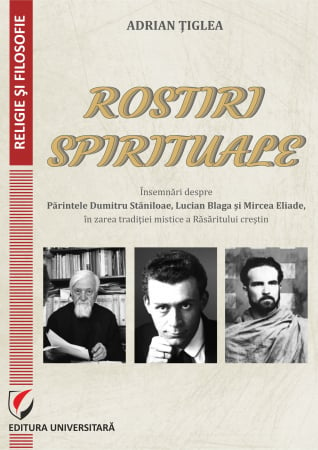


Philosophy of Communication


History and Theology

Longing - the Romanian condition of being - George Remete


On pedagogy - Immanuel Kant
