📦 FREE SHIPPING OVER 120 RON
Order Tracking Individuals / Sales: 0745 200 357 / Orders Legal Entities: 0721 722 783
Manuscript proposals: [email protected] : 0745 204 115

 EN
EN  Romana
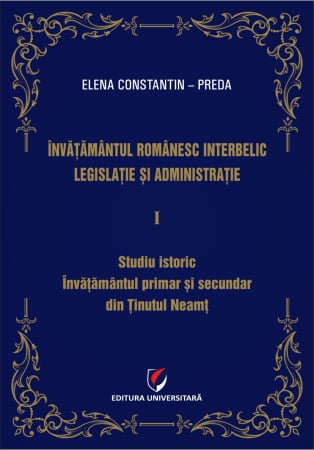
Elena Constantin-Preda is a history teacher, researcher and coordinator of educational projects, with a remarkable activity dedicated to the investigation of local history, education and German cultural heritage. She has published, as author, co-author or coordinator, numerous reference volumes, including: The Land of the Disappeared – Neamţ. History and Ethnography (Editura Universitară Publishing House, 2022), In the Footsteps of the Disappeared in Moldova. Historical and Ethnographic Study (2021), The Moldavian Boyars – History and Morals (2024), The Volvatir – the Cloth of All Times. A History of the Volvatir Factory in Târgu‑Neamţ (2025). She was also a co-author in the writing of school textbooks and applied history works, the History Manual for Grade VI (2023) and the History Manual of Communism in Romania (2025).
She led the destinies of the History discipline, as a school inspector at the Neamţ County School Inspectorate, between 2006 and 2023, she founded the Association of History Teachers of Neamţ (APIN), together with his fellow teachers, she was actively involved in local and national scientific and cultural life, by organizing symposiums, conferences and summer schools, having the privilege of coordinating collective volumes dedicated to Neamţ history and identity such as: Optional History Manual - Legend, tradition and history in the Neamţ Mountains (2011), German Identity (2012), Celebrating the Centenary of the Great Union in Piatra-Neamţ (2018), Carol II and the end of democracy. A king, a cult, a camarilla, 2018, Neamţ – the treasure land. Monograph (2019), Foray into the history of education in Romania (2020). She offered students and parents the opportunity to better understand the purpose of school through special works: The Guide to the Well-Informed Parent (2009), National Testing Preparation Guide - History of the Romanians - Solution Models (2007), History of the Romanians - Chronological Guide for National Exams (2006), History of the Romanians - Collection of Tests for Grade VIII (2004), We and our neighbors. The majority and the minorities in the recent history textbooks in Romania, Bulgaria and Hungary - With a case study: Republic of Moldova (“We and our neighbors in the history textbooks”) 2004. Her scientific concerns are confirmed by numerous studies and articles published in specialized journals or volumes of international conferences. Her papers, presented at academic events in the country and abroad, address topics such as the history of Romanian schools between 1918–1948, the analysis of interwar educational legislation, the history of school textbooks, or the condition of teachers in the 20th century.
She led the destinies of the History discipline, as a school inspector at the Neamţ County School Inspectorate, between 2006 and 2023, she founded the Association of History Teachers of Neamţ (APIN), together with his fellow teachers, she was actively involved in local and national scientific and cultural life, by organizing symposiums, conferences and summer schools, having the privilege of coordinating collective volumes dedicated to Neamţ history and identity such as: Optional History Manual - Legend, tradition and history in the Neamţ Mountains (2011), German Identity (2012), Celebrating the Centenary of the Great Union in Piatra-Neamţ (2018), Carol II and the end of democracy. A king, a cult, a camarilla, 2018, Neamţ – the treasure land. Monograph (2019), Foray into the history of education in Romania (2020). She offered students and parents the opportunity to better understand the purpose of school through special works: The Guide to the Well-Informed Parent (2009), National Testing Preparation Guide - History of the Romanians - Solution Models (2007), History of the Romanians - Chronological Guide for National Exams (2006), History of the Romanians - Collection of Tests for Grade VIII (2004), We and our neighbors. The majority and the minorities in the recent history textbooks in Romania, Bulgaria and Hungary - With a case study: Republic of Moldova (“We and our neighbors in the history textbooks”) 2004. Her scientific concerns are confirmed by numerous studies and articles published in specialized journals or volumes of international conferences. Her papers, presented at academic events in the country and abroad, address topics such as the history of Romanian schools between 1918–1948, the analysis of interwar educational legislation, the history of school textbooks, or the condition of teachers in the 20th century.