📦 FREE SHIPPING OVER 120 RON
Order Tracking Individuals / Sales: 0745 200 357 / Orders Legal Entities: 0721 722 783
Manuscript proposals: [email protected] : 0745 204 115

 EN
 Romana
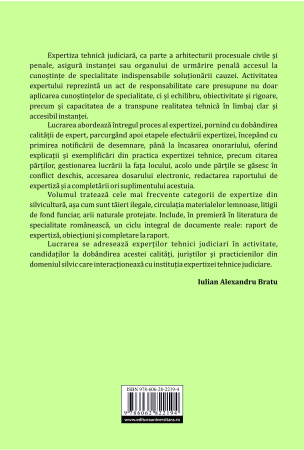
6359.png "Editura Universitară") Forensic technical expertise in forestry. From theory to practice


Publisher: Editura Universitară
Author: Iulian Alexandru Bratu
Edition: I
Pages: 102
Publisher year: 2026
ISBN: 978-606-28-2219-4
DOI: 10.5682/9786062822194
Product Code:
9786062822194
Do you need help?
0745 200 357
- Description
- Browse (1)
- More details
- Content
- Reviews (0)
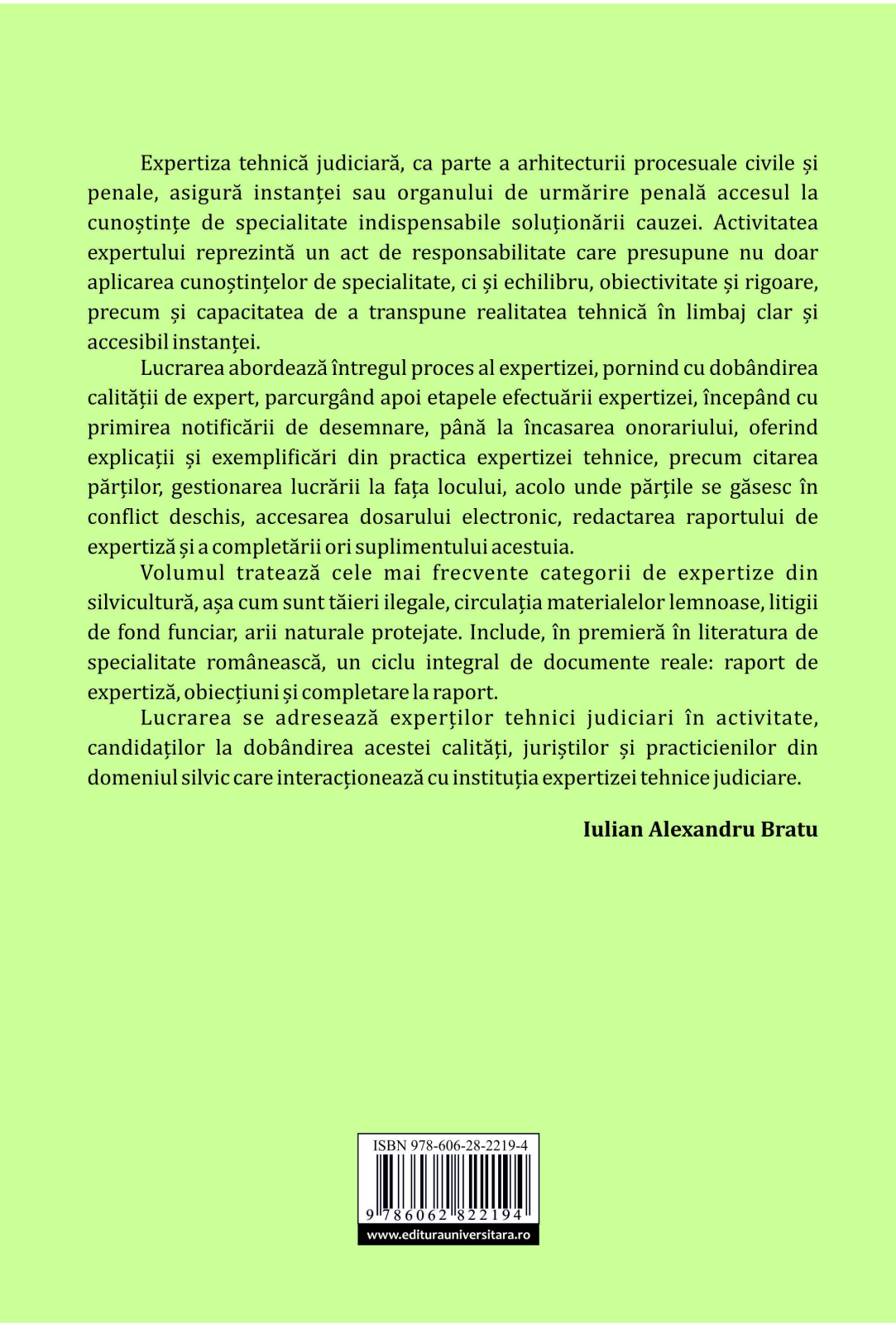
Judicial technical expertise, as a component of the civil and criminal procedural framework, provides the court or the criminal investigation authority with access to specialized knowledge essential for resolving a case. The expert’s work is an act of responsibility that requires not only the application of specialized knowledge but also balance, objectivity, and rigor, as well as the ability to translate technical reality into language that is clear and accessible to the court.
This work covers the entire expert examination process—from obtaining the status of an expert through the various stages of conducting an examination (starting with the receipt of the appointment notice and concluding with the collection of the professional fee). It provides explanations and practical examples from the field of technical expertise, addressing topics such as the summoning of parties, managing on-site inspections—even in situations where parties are in open conflict—accessing electronic case files, and drafting the expert report, as well as any subsequent addenda or supplements.
The volume addresses the most common categories of expert examinations in the forestry sector, including cases involving illegal logging, the transport and trade of timber, land tenure disputes, and protected natural areas. For the first time in Romanian specialized literature, it includes a complete set of actual documents: an expert report, objections, and a supplementary report.
This work is intended for practicing judicial technical experts, candidates seeking to qualify as such, and legal professionals or forestry practitioners who interact with the system of judicial technical expertise.
-
Forensic technical expertise in forestry. From theory to practice
Download
Forestry is a field where the law and nature sometimes coexist in a complex, challenging way. The forensic technical expert is the one called upon to translate this complexity into terms that the court can understand and use to uncover the truth. It is a serious responsibility and, at the same time, a profession that deserves full dedication.
This book arose from a genuine need I felt when I first began working as a forensic technical expert in forestry: the need for a practical guide written by someone with extensive experience and expertise—someone who has navigated every stage, made mistakes, and found solutions where the law remained silent.
The legislative framework governing forensic technical expertise exists and is accessible. However, the Code of Civil Procedure, the Code of Criminal Procedure, and Government Ordinance 2/2000 do not cover the practical steps an expert must take: what to do upon receiving the initial notification of appointment, where to begin, how to manage fieldwork when the parties are in open conflict, how to access the electronic case file, or how to proceed when the expert’s fee remains unpaid.
I extend my sincere thanks to Mihai Păltineanu, who generously provided the guidance I needed at the start of this professional journey. I am also grateful to my family, parents, teachers, and colleagues who believed in me; to my wife and sons, who showed great patience with me; and, last but not least, to Adela and Ciprian D. I am grateful to them all.
The Author
Preface / 9
Chapter 1. Theoretical Considerations / 11
1.1. The Necessity of Technical Expertise / 11
1.2. Status as a Judicial Technical Expert / 12
1.3. Appointment of a Judicial Technical Expert / 14
1.4. Recusal of a Judicial Technical Expert / 15
1.5. Conducting the Expert Assessment / 17
1.6. The Expert Report / 18
1.7. Financial Entitlements of the Expert / 19
Chapter 2. Practical Considerations / 20
2.1. Appointment of the Expert / 20
2.2. Preparation for the Expert Assessment / 21
2.3. Summoning the Parties / 22
2.4. On-site Expert Assessment / 24
2.5. Drafting the Judicial Technical Expert Report / 25
2.6. Professional Fees / 26
2.7. Tax Regime for the Technical Expert / 29
2.8. Sanctions / 30
Chapter 3. Extrajudicial Technical Expertise / 34
3.1. Status as an Extrajudicial Technical Expert / 34
3.2. Conducting an Extrajudicial Technical Assessment / 34
3.3. Contract for the Provision of Extrajudicial Technical Expert Services / 35
3.4. Stages and the Extrajudicial Technical Expert Report / 36
3.5. Utility of Extrajudicial Technical Expertise / 36
Chapter 4. Unlawful Felling and Theft of Trees / 38
4.1. Damage / 38
4.2. Loss / 38
4.2.1. Illegal felling of trees / 38
4.2.2. Forest saplings or shoots / 39
4.2.3. Theft of trees / 40
4.3. Unrealized forest functions / 40
Chapter 5. Circulation of timber materials / 42
5.1. Legislative framework / 42
5.2. Specifics regarding the circulation of timber materials / 43
5.3. Objectives of expert assessment regarding the circulation of timber materials / 43
Chapter 6. Technical expertise in forestry and the forest cadastre / 49
6.1. Legislative framework / 49
6.2. Land tenure disputes / 50
Chapter 7. Forest management planning. Protected natural areas / 52
7.1. Legislative context / 52
7.2. Environmental disputes / 53
Chapter 8. Delicate aspects and sensitive situations in the practice of judicial technical expertise / 56
8.1. How I became a judicial technical expert / 56
8.2. Where to consult information / 56
8.3. Relationship with the parties / 57
8.4. Procedural time / 58
8.5. Collection of fees / 58
Chapter 9. Judicial technical expert report (example). Objections. Completing the Report / 60
Bibliography / 95
Appendix 1 / 98
Appendix 2 / 99
Appendix 3 / 100
If you want to express your opinion about this product you can add a review.
write a review
Similar products

Civil Code (September 2026) – Edited by Prof. Dan Lupașcu, PhD

Constitution of Romania. Third Edition